HACCP in the "
"
Food Trailer: Hygiene Rules Explained Simply
You want to get your food trailer up and running—burgers, bowls, or
crêpes, whatever. No matter what you sell, there’s no getting around HACCP
. At first, that sounds like red tape and thick files. But it isn’t
. At its core, HACCP is nothing more than common
sense—systematically written down. This article shows
you what’s behind it, what you need in your day-to-day operations, and how a
well-designed trailer can already do half the work for you.
What exactly is HACCP?
HACCP stands for Hazard Analysis and Critical Control
Points — in German: Gefahrenanalyse und kritische
Kontrollpunkte. The concept originated in NASA kitchens in the
1960s and is now mandatory throughout Europe for anyone who commercially
produces or sells food.
The idea behind this is that you take a look at your entire process—from
buying the ingredients to the finished dish—and ask yourself at every
step: Where could something go wrong? Where do I need to check? And what
do I do if the check shows that something is wrong?
No legal jargon. No lab. Just a clear view of your
everyday life.
Does HACCP also apply to food
trailers?
Short answer: Yes, definitely.
EU Regulation (EC) No. 852/2004 on food hygiene applies to
all food business operators—and that includes you from the very first day
you start selling food. Whether you run a restaurant kitchen, a catering business, or an HACCP food
trailer: The requirement to conduct self-inspections in accordance with HACCP principles applies
just the same.
When selling on the street or at markets, this means: You are your
own hygiene officer. The relevant veterinary or
food safety authority can drop by at any time and ask to see your
documentation. If you’re well prepared, you have nothing to
fear.
The 7 HACCP Principles —
Explained Simply
- Hazard Analysis: Where might biological, chemical
or physical hazards arise? (e.g., bacteria in ground meat,
cleaning product residues, foreign objects) - Identify critical control points (CCP): Which
steps are essential for eliminating a hazard?
(e.g., cooking meat thoroughly) - Setting limits: At what temperature,
pH level, or time is a CCP considered safe? (e.g.,
core temperature ≥ 75 °C) - Setting up monitoring: How and how often is
checked? (e.g., temperature measurement for each batch) - Planning corrective actions: What happens if a
threshold value is not met? (e.g., let the food sit longer or
dispose of it) - Verification: Does the system really work?
(e.g., calibrating thermometers, checking lists) - Documentation: Write everything down—what, when, who,
and the result
Practical
HACCP Measures in Everyday Trailer Operations
Maintain the cold chain
Foods that require refrigeration must be stored at a constant temperature of +7 °C or lower
, while raw meat and fish must be kept at +4 °C or lower. Your refrigerator in the trailer
should have a built-in thermometer—and you should record the temperature
in the morning, at noon, and after your shift. Never break the cold chain
for longer than absolutely necessary.
- Store goods immediately upon delivery
- Don't overfill the refrigerator (to allow for air circulation!)
- Store frozen foods separately from fresh foods
Hand Hygiene and
Work Clothing
Your hands are your most important tool—and the most common source
of contamination. Wash your hands after:
- going to the bathroom
- Handling money
- Touching raw meat or eggs
- Coughing, sneezing, touching your face or hair
Wear light-colored work clothes that you change regularly. Any cuts
must be covered with a waterproof, colored bandage—so that you
notice right away if it comes off.
Cleaning and Disinfection
Work surfaces, cutting boards, and utensils are cleaned
after each use—and disinfected as needed. The difference: Cleaning
removes dirt, while disinfection kills germs. The two go hand in hand.
- Use separate cutting boards for raw meat and other ingredients
- Never store cleaning supplies and food together
- Change or disinfect cloths and sponges daily
Pest Prevention
The same rules apply in the trailer as in any professional kitchen: don’t
leave food out overnight, keep trash in sealed
containers, and seal any openings and access points. If you suspect pests
, act immediately and document the situation.
Documentation
You don't need 50-page binders. But you do need:
- A temperature log (refrigerator +, if applicable,
freezer, daily) - A cleaning schedule (what gets cleaned, when, and how
) - Keep records of goods received (delivery notes
) - A certificate of completion for you and your team
HACCP Documentation:
What do I need to record?
The good news is that the effort involved is manageable if you use a
simple system. Many government agencies accept handwritten
lists—as long as they are complete and accurate.
Minimum requirements for a HACCP food
trailer:
Tip: There are free HACCP templates available for mobile food service, such as
from the German Hotel and Restaurant Association (DEHOGA) or from your local veterinary office
.
How AVB
manufactures HACCP-compliant trailers
A well-designed trailer makes hygiene easier—not harder. This starts
with the choice of materials and doesn't end with the layout of the space.
At AVB Manufaktur, we build every trailer so that you can handle your
day-to-day HACCP tasks without any unnecessary hassle:
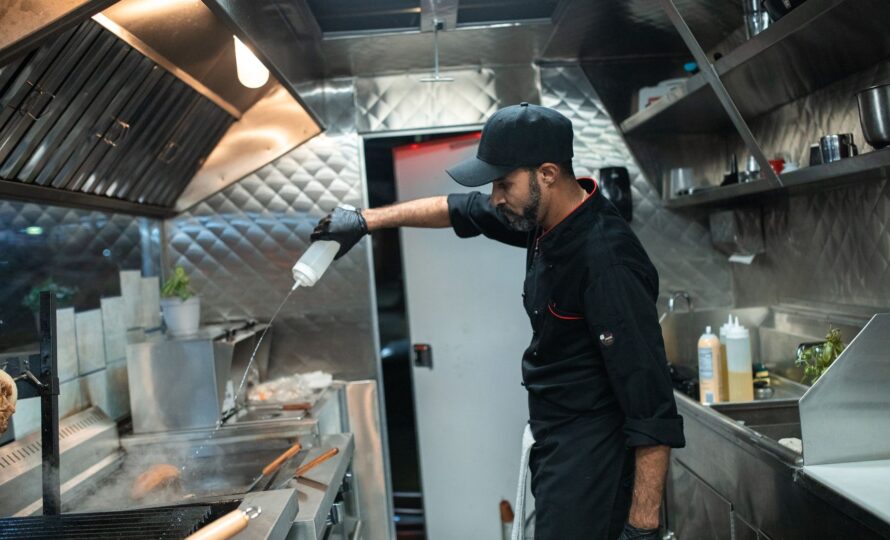
- Surfaces: All work surfaces are made of
food-safe stainless steel — seamless, easy to clean, with no
hiding places for germs - Wall coverings: Smooth, washable materials,
no cracks, no edges - Water & Wastewater: Integrated fresh water
and wastewater tanks compliant with DIN standards, optionally with a hot water boiler —
Hand washing available at any time - Refrigeration systems: Built-in refrigerators with separate
Zone temperature control available upon request - Lighting: Bright LED lighting so you can
see any debris right away - Pest control: All openings sealed; no dead spaces in the structure
This isn't something to be taken for granted—it's craftsmanship.
Every trailer is custom-designed so you're on the safe side right from the start at
.
Conclusion
HACCP in a food trailer isn’t just a paper tiger. It’s the system that
protects you and your customers—and gives you peace of mind
during the next inspection. If you know your process, document your temperatures
and work cleanly, you’ve already done most of the work.
The rest starts with the right trailer.
,
are you looking for a trailer that’s built to HACCP standards—right from the start?
Then let’s talk. We’ll take the time to listen to your idea, take a look
at your business together, and build you a trailer that not only
looks great, but also passes
the next food inspection.
→ Visit
now
Request a consultation — free of charge and
with no obligation.
Meta: HACCP in food trailers, explained simply:
Principles, checklists, and tips for your daily routine. Here’s how to set up your
hygiene plan step by step.