An honest guide for entrepreneurs, restaurant owners, and career changers:
Mobile food service is booming. Food trucks can be found at street food festivals, farmers’ markets, company courtyards, and weddings. At the same time, we also hear about failed concepts, unrealistic expectations, and budgets that are too tight.
The key question, therefore, is not “Is a food truck cool?”, but also:
When is a food truck or food trailer really worth it—financially, logistically, and personally?
This Magazin you with clear, practical information. No sugarcoating. Just experience in planning, building, and supporting mobile catering concepts.
What is a food truck or food trailer?
Before we talk about economic efficiency, it is worth clearly defining the terms.
Food truck – the mobile kitchen.,
A food truck is a motorized vehicle with a permanently installed kitchen. You drive to the location yourself, open up, and sell your food.
Typical characteristics:
-
Its own chassis with an engine,
-
Kitchen permanently integrated into the vehicle
-
High flexibility when relocating
-
Higher purchase and maintenance costs.
Food Trailer – the versatile food truck.
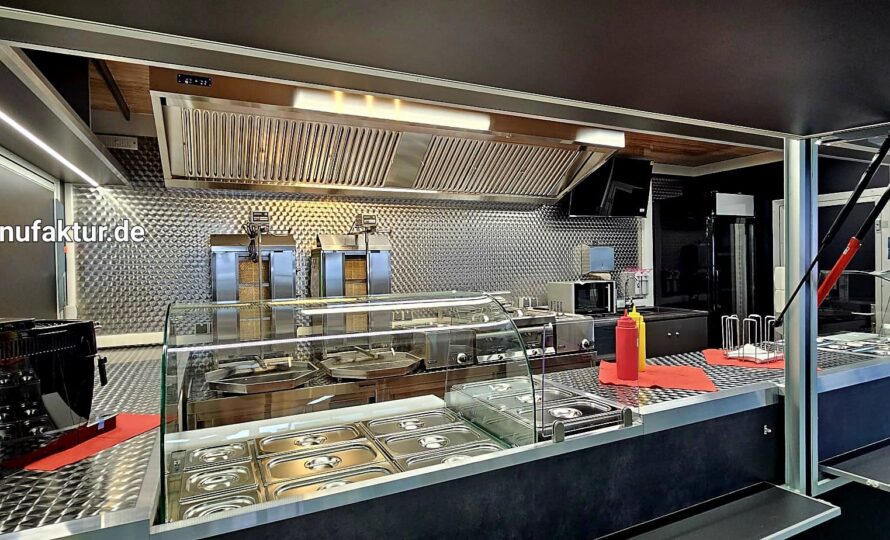
A food trailer (also known as a sales trailer or snack cart) is a trailer without its own drive system. It is moved by a towing vehicle.
Typical characteristics:
-
lower upfront costs,
-
Separation of vehicle and kitchen
-
Flexibly scalable (one tractor unit, multiple trailers)
-
Especially popular at events, markets, and for catering.
Typical applications for both variants:
-
Street food festivals
-
weekly markets
-
Corporate events & event catering,
-
Weddings & private events
-
Addition to existing catering facilities
Both concepts belong to the mobile catering sector —but differ significantly in terms of costs, handling, and deployment strategy.
When is a food truck really worthwhile?
The honest answer: Not automatically—only under certain conditions.
A food truck or food trailer is worthwhile when several factors come together.
1. A clear gastronomic concept
The offer is what matters most. Successful mobile concepts are:
-
clearly positioned (not everything for everyone),
-
can be produced quickly,
-
Consistent in quality and taste.
Typical examples:
-
Burgers & Smashburgers,
-
Pizza & tarte flambée,
-
Bowls & Street Food Cuisine
-
Coffee and dessert concepts
-
Regional specialties
The simpler the concept, the easier it is to implement on the go—even when there are large crowds.
2. The right target audience & suitable locations..
A food truck thrives on foot traffic. Without people, there is no revenue.
Important questions:
-
Where is your target audience located?
-
Office district, city center, weekly market, or event?
-
Regular locations or changing festivals?
A good location can make an average food truck profitable. A bad location will ruin even the best concept.
3. Demand, Competition, and Seasonality:
Mobile catering is often dependent on the weather and season.
Street food festivals do not run all year round. Weekly markets do—but with limited frequency.
Honest planning means:
-
Analyze the competition,
-
Take seasonal fluctuations into account,
-
Consider alternatives such as catering or corporate clients
4. Your personal goals:
A food truck is worthwhile to varying degrees, depending on what you want:
-
Full-time business start-up
-
supporting leg
-
Expansion of an existing facility.
Not every goal requires the same size, investment, or utilization.
Profitability: Costs, Revenue, and Break-Even.
Now it's getting real. And honest.

Investment costs – what to expect:
The acquisition costs depend heavily on the design, size, and equipment.
Typical cost categories:
-
Buy a food truck or food trailer (new or used),
-
Interior Design & Kitchen Appliances,
-
Electricity, gas, water, ventilation,
-
Refrigeration, countertops, storage space,
-
Wrapping & Branding,
-
Inspections (TÜV, gas, electrical),.
-
Insurance & Permits.
A food trailer is usually significantly less expensive than a full-fledged food truck—especially when starting out.
Everyday running costs:
Many people underestimate this point.
These include:
-
cost of goods sold
-
staff
-
Booth and event fees,
-
Energy (electricity, gas, water),
-
Maintenance & Repairs
-
cleaning
-
Marketing & Social Media
-
Insurances
These costs determine your profit margin, not just your sales.
When does a food truck become worthwhile?
Put simply:
-
How much revenue do you generate per day of work or event?
-
How many days per month do you realistically work?
-
What remains after all costs have been paid?
The break-even point is reached when your investment has been recouped by the profit generated. This often takes longer than expected—based on realistic calculations, not embellished ones.
Typical use cases: Where a food trailer is particularly useful
1. Weekly market or permanent stall
Opportunities:
-
Predictable revenues
-
Regular customers
-
Clear processes
Risks:
-
Limited frequency
-
weather dependency
A food trailer with an efficient interior layout is often worthwhile here.
2. Street food festivals & events
Opportunities:
-
High sales in a short period of time
-
Good visibility
-
brand building
Risks:
-
High stand fees
-
Variable quality of events
Without fast processes and sufficient capacity, it becomes stressful—and unprofitable.
3. Corporate and private events, catering
Opportunities:
-
High planning reliability:
-
Good margins
-
Less weather risk
Risks:
-
acquisition costs
-
High standards of reliability.
Many successful operators combine events with catering.
4. Addition to existing catering facilities
Restaurants, bakeries, and butcher shops use food trucks as
-
marketing tool
-
additional revenue
-
Test field for new locations
Mobile catering is particularly worthwhile here.
Food truck vs. food trailer: Which solution is right for you?
Food truck – advantages and disadvantages
Advantages:
-
Maximum mobility
-
No separate towing vehicle required
Disadvantages:
-
High acquisition costs
-
Expensive repairs
-
Standstill due to vehicle breakdown
Food trailers – advantages and disadvantages
Advantages:
-
Lower investment costs
-
Flexible use
-
One towing vehicle for multiple trailers
-
Simpler maintenance
Disadvantages:
-
Maneuvering and parking require practice
-
Dependence on the towing vehicle
A food trailer is often the more economical solution, especially for founders and businesses with expansion plans.
Legal framework & planning security
A food truck is only worthwhile in the long term if it is planned in a legally compliant manner.
Key points:
-
Business registration,
-
Hygiene regulations (HACCP),
-
Building and fire protection
-
Stand permits
-
Inspections (TÜV, gas, electrical)
Errors in planning cost time, money, and nerves later on. That's why a well-planned interior design is crucial—not only visually, but also functionally and in terms of compliance with standards.
Step by step: How to determine whether a food truck is worthwhile for you
-
Clearly define the food concept,
-
Determine the target audience and locations,
-
Analyze competition
-
Calculate investment and running costs realistically
-
Consider pricing and revenue scenarios,
-
Plan deployment days realistically
-
Check legal requirements,
-
Making a decision: food truck, food trailer, or alternative
The more honest you are here, the better the decision will be.
Conclusion: Who would particularly benefit from a food trailer?
A food truck or food trailer is worthwhile if:
-
your concept is clear and feasible
-
Locations and target group are a good fit
-
Costs are calculated realistically
-
you can respond flexibly to the season and demand
Food trailers in particular offer many advantages:
-
lower entry costs
-
high flexibility
-
Individual planning instead of off-the-shelf solutions
A customized sales trailer that fits your concept saves time, money, and stress in everyday life—and that's exactly what matters in mobile catering.
If you plan realistically, calculate carefully, and focus on quality, mobile catering can be more than just a trend: it can be a sustainable, honest business model.