You have a concept, a brand, and a color scheme in mind. Now you want to bring your vision to life in the best possible way. The only question left is: paint or wrap? Many restaurant owners underestimate just how big the difference between the two options really is—and how much more design freedom a wrap offers compared to paint.
The Dilemma When Buying a New Car: Standard or Custom?
A new food trailer from AVB-Manufaktur usually comes in a standard color: silver, black, or red. While this look certainly makes an impression given the high quality of these trailers, restaurateurs are usually looking for that special something. You want to see your logo, your color, and your name on your food trailer.
You have two options: have it repainted or have it wrapped. Both can improve the appearance of your trailer. But if you take a closer look, you'll quickly realize that one of the options makes a little more sense.
Wrapping vs. Painting: The Big Comparison
Reversibility
A vinyl wrap can be removed without leaving any residue. This means you can flexibly change your design at any time, update your name, or find another use for the trailer without making any major changes to it. A paint job, on the other hand, is permanent.
This is a real advantage for restaurant owners who are looking to further develop their concept, run seasonal promotions, or eventually sell or rent out their food truck.
Design Freedom
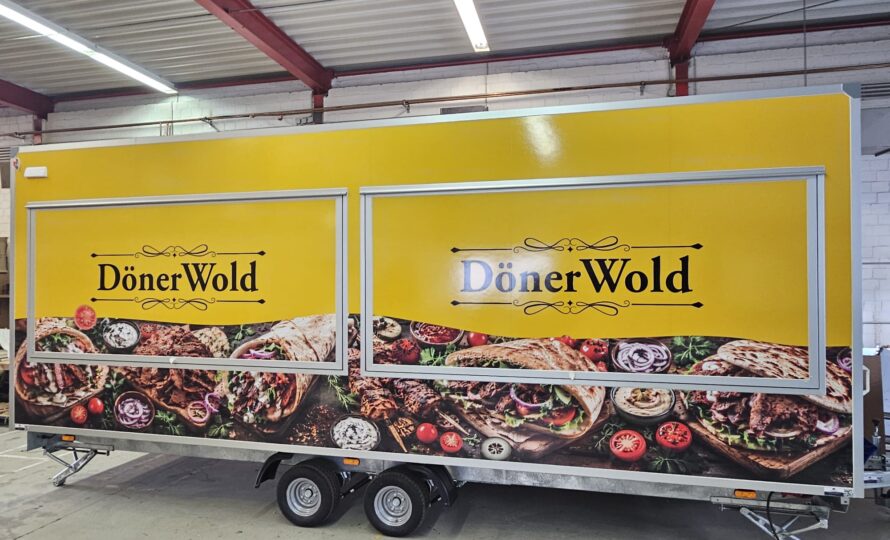
Wrapping allows for the reproduction of photo prints, color gradients, textured surfaces (carbon fiber, matte, chrome), and complex graphics in high resolution. With paint, such effects are either impossible or extremely expensive.
If you want a photorealistic design, a specific gradient effect, or a unique look, vinyl wrapping is the way to go. You can browse a wide variety of the most creative designs on our website. It’s definitely worth having your food trailer wrapped by us.
Protection of the base coat
A high-quality film protects the underlying surface from the elements, UV rays, and minor scratches. If you want to restore the trailer to its original condition later on, you’ll find the surface underneath in perfect condition.
Costs and Flexibility
A professional full-vehicle wrap is generally much less expensive than repainting the car in a custom color. And it can be redone after a few years if the design fades or the concept has evolved.
What Paint Does Better
Paint is more durable. A well-applied coat of paint will last 10 to 15 years—or longer—with proper care. For operators who view their concept as completely set in stone and do not plan to make any design changes, paint may be the more durable choice.
Paint also feels more natural on some surfaces, especially on high-quality trailers where preserving value is a priority.
What Is Often Overlooked When Customizing
The windows and hatches play a role in the decision.
The location of service hatches, dispensing windows, and doors determines which surfaces are available for branding. Those who buy a ready-made trailer and then want to apply vinyl graphics sometimes find that the beautiful logo is located right behind a hatch.
At AVB Manufaktur, we plan everything together from the very beginning: Which surfaces should be used for advertising? Where should the logo go? How large is the main display area? We address these questions during our initial planning meetings.
The base color and the film must match
A vinyl wrap changes the appearance, but the base color of the exterior trim shows through slightly in transparent areas. If you’re working with a lighter base color, you’ll have more leeway for intense colors. If you want a bold yellow in the vinyl wrap, you’ll ideally need a light-colored base.
Vehicle Wrapping vs. Repainting: Which One Pays Off in the Long Run?
| Criterion | Wrapping | Repainting |
|---|---|---|
| Costs (Full Area) | 2,500–6,000 € | 3,500–10,000 € |
| Design Freedom | Very high – photo printing, color gradients, textures | Medium – Classic Opaque Paints |
| Reversibility | ✓ Removable without leaving any residue | ✗ permanent |
| Durability | 5–7 years | 10–15 years |
| Renovation Costs | Medium | High |
| Preserving the Value of Floor Space | ✓ The film protects the surface | ✗ not reversible |
For most food trailer concepts, vinyl wrapping is the more cost-effective and flexible solution. There are exceptions, but they are rare.
How We Think at AVB Manufaktur
None of our food trailers are off-the-shelf. Every project begins with a planning meeting, during which we discuss your concept, your workflows, and your budget together. We take the time to address your individual needs and preferences. The interior and exterior design of the trailer is tailored precisely to your specifications. We provide helpful advice and explain what is and isn’t possible.
We provide thoughtful, reliable, and practical advice. Our plans are then carefully brought to life through precise, meticulous craftsmanship.
Tell us what you have in mind, and we'll make it happen—because customer satisfaction is our top priority. We're just as unwilling to compromise here as we are when it comes to the quality of our products.
Frequently Asked Questions About Vinyl Wrap vs. Paint on Food Trailers
Can I apply vinyl wrap to a trailer that has already been painted?
Yes. As long as the paint is intact and has no deep scratches or bubbles, it works well as a base for a wrap. The wrap actually protects the paint.
What happens if I want to remove the film later?
High-quality cast films can usually be removed completely and without leaving any residue, especially if they aren't too old. The original surface underneath will then be in the same condition as it was before the film was applied.
How many color options are available for a vinyl wrap?
Modern films are available in hundreds of colors and finishes: matte, glossy, satin, metallic, carbon-look, chrome, and many more. In addition, there are digitally printed designs featuring custom graphics. The design possibilities are significantly greater than with paint.
This content was created with the help of AI and was reviewed and edited by our editorial team prior to publication.