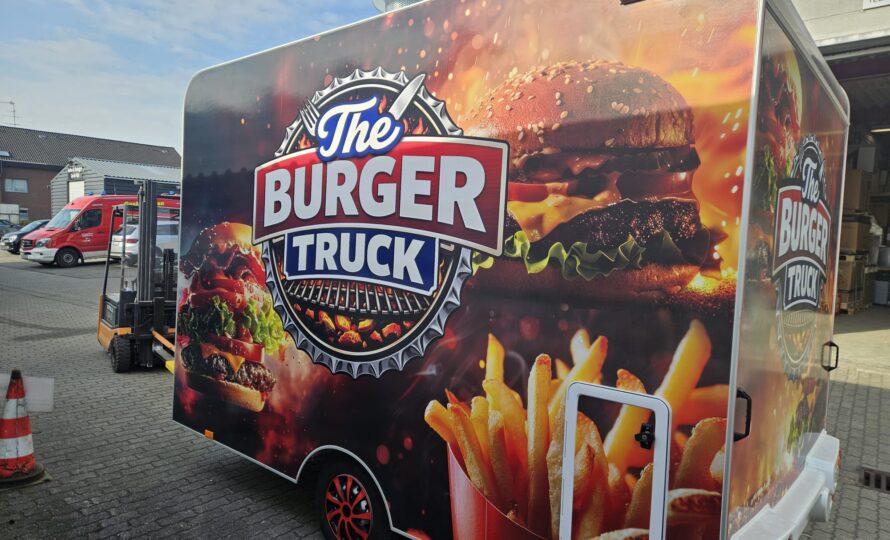
Your food trailer is a common sight in public. People see the exterior before they even read your menu. Vehicle graphics are one of the most effective and cost-efficient forms of advertising available to a food trailer business. When done right, your trailer is visible 365 days a year. This Magazin shows you what makes professional vehicle graphics stand out and how to get the most out of them.
Why Vehicle Graphics Are So Effective for Your Food Trailer
A food trailer on the road or at a market attracts attention. That’s themain advantage of mobile food service. Branding turns that attention into brand recognition. People remember colors, logos, and lettering faster than names or addresses.
According to a study by the Association of the German Advertising Industry, vehicle advertising is among the most cost-effective forms of advertising in terms of cost per thousand impressions. A branded food trailer with a highly visible full-wrap design generates hundreds of thousands of visual impressions per year, with no ongoing monthly costs.
What Vehicle Graphics Can Do
- Immediate recognition of the concept and the brand
- Advertising with no ongoing costs after the initial investment
- A professional appearance that builds trust
- Coverage at events, in parking lots, and on the go
What Goes Into Professional Vehicle Graphics
The lettering
The name and key message must be legible from a great distance. Recommendation: Use a font size of at least 15 cm for the main name. High-contrast color combinations (dark on light or vice versa) significantly improve legibility from a distance.
Avoid using too many fonts in one area. One or two fonts are enough. Anything more than that makes the design look cluttered.
The Logo
Your logo is the visual centerpiece of your brand identity. It needs enough space to make an impact. On a typical food trailer, we recommend a logo size of at least 40 x 40 cm on the front.
Color Selection
Colors determine brand recognition and brand personality. Choose colors that fit your concept and use them consistently: on the trailer, on packaging, and on social media.
Contact Information and Social Media
Every professional vehicle wrap should include an Instagram handle, a website, and, if applicable, a phone number. The font size must be large enough to be readable as people walk by.
Full Wrap or Partial Decal: Which One Is Right for You?
Full Vehicle Wrap / Full-Body Vehicle Wrap
The entire exterior surface of the trailer is covered with vinyl wrap. This allows for large-scale designs, complete color changes, and a consistent look across all surfaces. Full-vehicle wrapping is the most impactful form of vehicle advertising. Costs can vary significantly depending on the size and complexity of the lettering.
Part Labeling
The logo, name, slogan, and contact information are strategically placed on selected areas. The result looks professional, and the effort required is minimal. For many food trailer concepts, this is the right choice. The costs are significantly lower here than with a full wrap.
Digital printing on a single surface
Photorealistic images or high-quality graphics are printed on individual side panels or the rear section. This is effective when there is sufficient space. It also combines well with partial lettering.
Vehicle Decal Films: Which Material Offers the Best Value?
Professional vehicle graphics use cast vinyl. It conforms to contours, adheres better, and looks neater than inexpensive calendar-grade vinyl. A protective laminate extends its durability and shields the print from UV rays.
Inexpensive vinyl without a laminate layer fades quickly and no longer looks professional after a year. This does more harm to the brand image than having no vinyl at all.
How to Plan Your Vehicle Graphics the Right Way
Step 1: Define the Concept and Brand Image
Colors, the logo, the font, and the key message must be clearly defined before hiring a graphic designer or a window-wrapping company.
Step 2: Record the trailer's dimensions
Accurate dimensions are the foundation for print-ready files. We provide our customers with technical drawings that include all relevant dimensions.
Step 3: Contact AVB-Manufaktur
Vehicle wrapping is a craft. Experience and tools determine the outcome. Ask to see past projects and check the quality of the edges and corners.
Step 4: Plan for Maintenance
Professionally wrapped trailers stay looking fresh longer when they are maintained regularly. Do not apply high pressure directly to the wrap; use mild cleaning agents.
AVB Manufaktur: Branding Considered from the Very Beginning
We build food trailers where branding isn't an afterthought. The service hatch, serving window, and door placement are planned from the very beginning to ensure the signage areas are just right. We'll provide you with detailed plans.
Your trailer should be recognizable on the road. That takes more than just a wrap. It takes a well-thought-out plan.
We'd be happy to advise you in person at our workshop.
Frequently Asked Questions About Vehicle Decals
What is the difference between vehicle lettering and full-body wrapping?
Vehicle graphics generally refer to the targeted application of logos, names, and information to selected areas. Full-wrap graphics cover the entire trailer with vinyl film, allowing for complete color changes and large-scale designs.
Can I remove my existing vehicle decals myself?
Well-adhered cast films can usually be peeled off without leaving any residue, especially when the lettering is relatively new. For old or low-quality films, we recommend hiring a professional to avoid leaving marks on the surface.
How long does professional food trailer lettering last?
With cast film and laminate, a lifespan of 5 to 7 years is realistic with proper care. Regular cleaning and avoiding high-pressure cleaning significantly extend the lifespan.
*This content was created with the help of AI and was editorially reviewed and revised prior to publication.*